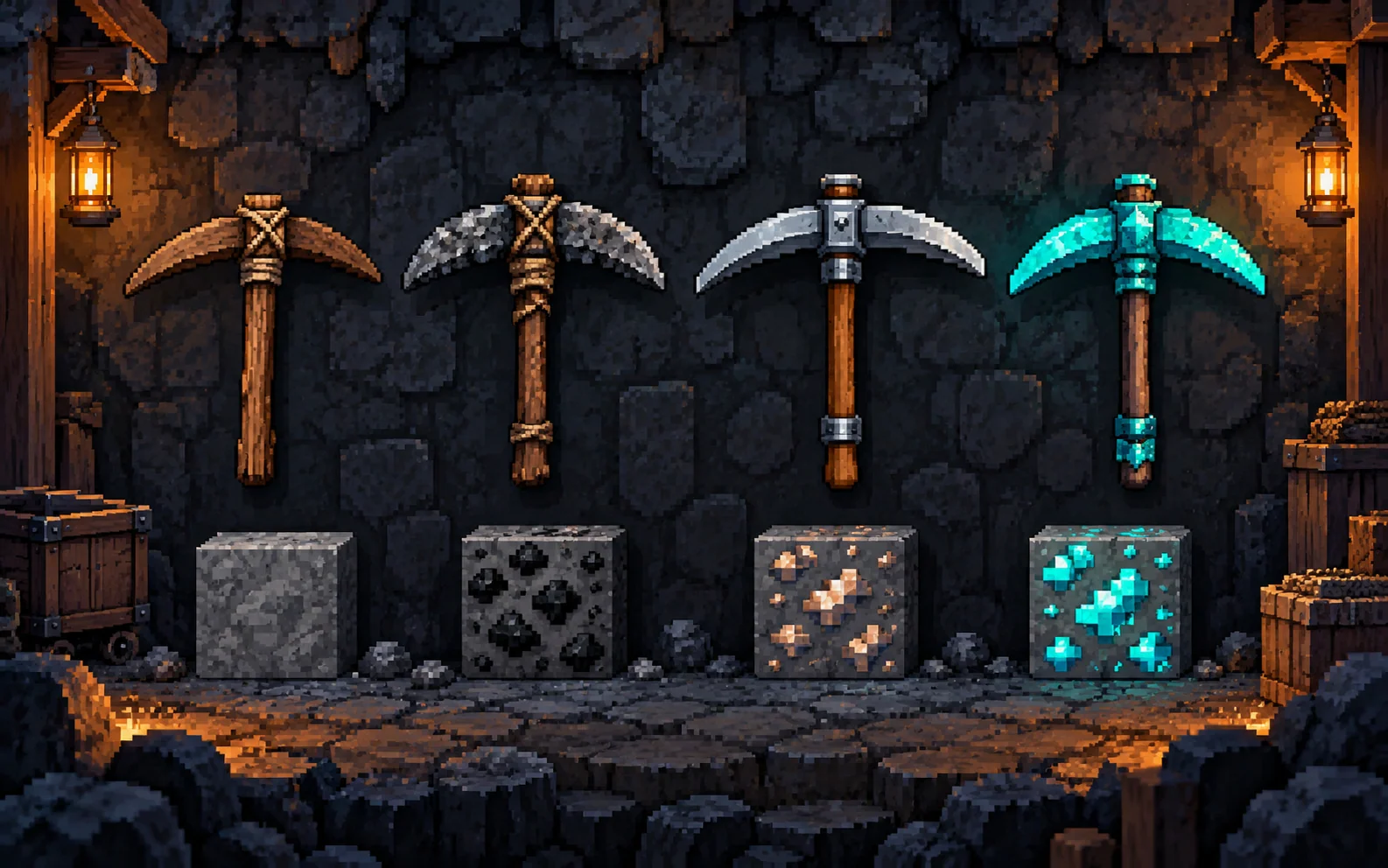
Block awards in the official Rules
| Block | Award multiplier |
|---|---|
| Dirt | 0× |
| Stone | 0× |
| Copper | 0.01× |
| Redstone | 0.05× |
| Gold | 0.2× |
| Diamond | 1× |
| Emerald | 5× |
Source: Pixmove’s English demo Rules, checked on 16 October 2026. The game pays for breaking the block. See Pickaxes & Blocks for the hits needed and the effects that can change a fall.
The Rules describe TNT, Upgrade Arrow and Workbench as effects on the fall and list no direct cash award for them. They give no separate payout multiplier for size or depth.
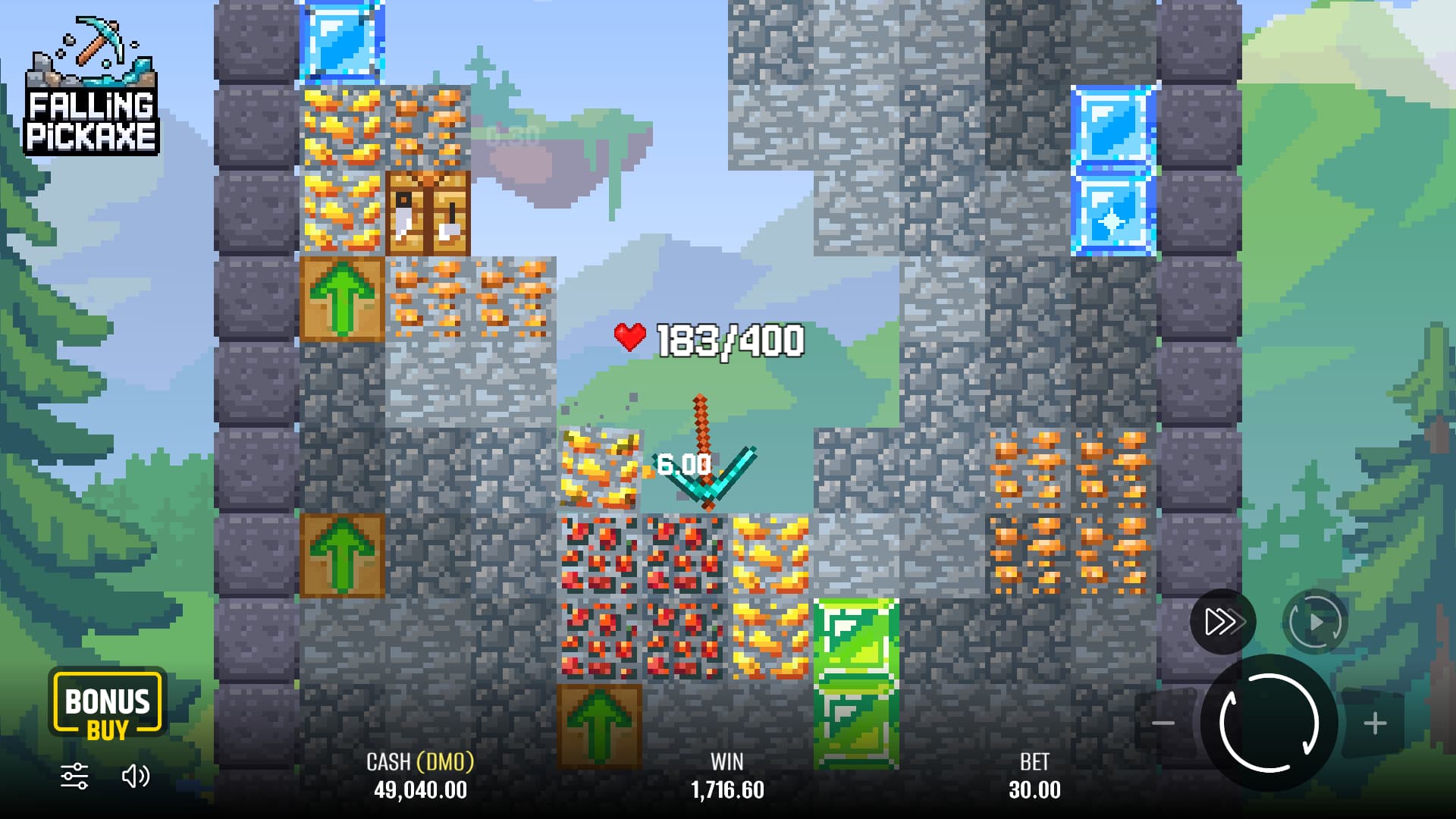
How to calculate a round award
For the block rewards described above:
Total award multiplier = sum of each destroyed ore’s multiplier.
Round payout = bet × total award multiplier.
Count only the ore you break. Two Gold blocks pay 0.4×. One Gold and one Diamond pay 1.2×. This calculation starts with known blocks. It can’t recreate the field or tell you how the game applies the overall cap.
Example: one Diamond and one Gold
Assume a 10-unit bet, one destroyed Diamond and one destroyed Gold, with no other awards or separate costs. The multiplier is 1 + 0.2 = 1.2×. The payout is 10 × 1.2 = 12 units. Subtracting the 10-unit stake gives 2 units of net gain in this simplified example.
Start with 100 units in that example. The bet takes the balance to 90 and the 12-unit payout brings it to 102 units. This assumes no other rounds, purchases or transactions.
Example: several small ore awards
Assume the same bet, two Copper blocks, one Redstone and one Gold. Their total is (2 × 0.01) + 0.05 + 0.2 = 0.27×. The payout is 2.7 units, which is 7.3 units less than the stake. Getting an award back doesn’t mean you came out ahead.
Example: one Emerald
With a 2-unit bet, a single Emerald contributes 2 × 5 = 10 units. If that were the entire award and there were no other costs, the net gain would be 8 units.
The examples use assumed blocks and stakes. They stay below the maximum and leave currency units and rounding to the client. For a real round, use the result recorded by the game.

Why is my payout zero or lower than my bet?
The animation can show activity without producing a profitable result:
- A Cross gives no pickaxe and therefore no mining sequence or ore awards from that spin.
- Breaking Dirt or Stone contributes no direct award. Hitting ore is also different from destroying it: the block must reach zero HP to meet the described reward condition.
- Destroying ore can produce a positive total that is less than 1× the bet. That is a partial return of the stake, as the 0.27× example shows, rather than a net gain.
When comparing the displayed result with a balance change, account for the stake already deducted and any other spins or accepted purchase costs. If an operator’s recorded transaction still does not match, keep the round identifier and the recorded stake and payout for its support team. These examples cannot reconstruct a missing round or confirm a payment error.
Settlement, manual cash out and withdrawals
| Term | Meaning in this context |
|---|---|
| Round settlement | Under the Rules, accumulated block awards are awarded when tool HP reaches zero. |
| Manual cash out | A player action to lock in an unfinished round’s result. The inspected Falling Pickaxe Rules do not describe such a control. |
| Account withdrawal | Moving an operator-account balance out through that operator’s payment process, under its own terms. |
Stopping Auto interrupts repeated spins. The Rules don’t give you a way to lock in the running total while the tool is falling.
Demo credits are not withdrawable money. For operator listings and the limits of the checks performed, see Where to Play. This paytable makes no promise about withdrawal methods, eligibility or processing times.
Why the paytable is not a probability table
The 5× for Emerald tells you how much it pays if it breaks. To work out the odds or expected payout, you’d need to know how often the tool destroys it. See RTP and volatility for what Pixmove publishes about return.
Frequently asked questions
Does a ×1 award mean I doubled my stake?
No. A 1× award returns the stake. If that’s your only award and you paid no extra costs, you break even.
Do the examples include Bonus Buy pricing?
No. They illustrate ordinary block-award arithmetic only. Buy Bonus uses a higher displayed bet to guarantee a starting tool; include that charge when comparing an award with spending. The rules guide lists the observed demo prices.
Can this page calculate the next payout?
No. A paytable converts known destroyed blocks into an amount. It does not predict which blocks will be destroyed or their probabilities.
Sources and scope
Pixmove’s product page gives the published figures. We read the English Rules in the demo to check how the game works. The dates below show when we consulted each source. We didn’t test paid rounds, autoplay, purchases or withdrawals.
- Rules in Pixmove’s official demoOfficial Rules · consulted 2026-10-16
We opened Play Demo and read the English Rules on 16 October 2026. They cover the reel, HP, awards, effects, controls and settlement. We didn’t spin, start Auto or buy a feature. The client showed no build number.
- Pixmove official demo: Buy Bonus menuProvider statement · consulted 2026-10-19
Buy Bonus showed Wooden, Stone, Iron and Diamond at 100, 150, 200 and 400 HP. At 10 DMO the bets displayed were 29.90, 56.50, 84.40 and 105.00. At 30 DMO they were 89.70, 169.50, 253.20 and 315.00. The menu showed a 10–20,000 DMO base-bet range. We didn’t press ACTIVATE, Spin or Auto. These are demo prices and limits. We didn’t audit the feature’s RTP.

Written by
Mark Roberts writes the English guides to Falling Pickaxe and compares it with other mining games.
Published